Thursday, 4 August 2022

The Sangh's Hypocrisy on Dalits, It's Time to Read 'Bunch of Thoughts', Again!
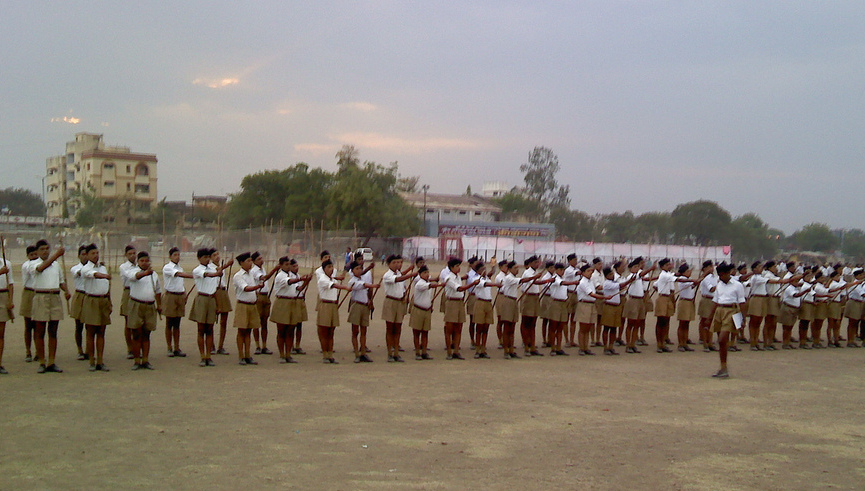
 

The Sangh's Hypocrisy on Dalits, It's Time to Read 'Bunch of Thoughts', Again!


Image Courtesy: Ganesh Dhamodkar Wikimedia Commons

'Bunch of Thoughts' by 'Guru' M.S. Golwalkar needs to be re-visited to understand where the Sangh and Its Votaries Stand on Caste, and Dalits

If one historically traces the ideology guiding the BJP and the Sangh, one can notice the deep impact of Brahmanical hegemony on them.


Soon after the PM’s condemnation of the Una incident in his post “Mann Ki Baat” address, the Rashtriya Swayamsevak Sangh (RSS) also criticised the attack on Dalits. The timing of the two statements, expose the hollowness of the condemnations expressed. The attack on Dalit youth in Una (Gujarat) took place on July 11 and the Prime Minister spoke against it only on August 6.

Both the statements were made almost a month after the Una incident. The “seriousness” of the RSS is also evident from the fact that, along with condemnation, it added that the “Prime Minister should have not called 80 percent Gau Rakshaks fake”. It must also be noted that while the Vishwa Hindu Parishad (VHP), an offshoot of the RSS, chose to remain officially silent, functionaries of both the VHP and Bajrang Dal (BD), another sister outfit, tweeted “Garv se kaho hum gorakshaks hai” (We are proud to be Cow Protectors), a play on their trademark slogan “Garv se kaho hum Hindu hai” (We are proud to be Hindus). The latter slogan was a call to arms, virtually in the 1990s as the campaign for the demolition of the Babri masjid built up.

Timing apart, the question that needs to be asked is, are the Sangh and BJP actually concerned about the atrocities on Dalits? Are they serious about the question of caste? One needs to look back a bit to find the answers.

If one historically traces the ideology guiding the BJP and the Sangh, one can notice the deep impact of Brahmanical hegemony on them. One must ask why the leadership of the Sangh has always been in the hands of the upper castes. Five of its six sarsanghchalaks (chiefs/supremos), including the present incumbent Mohan Bhagwat, are Brahmins. The only exception was Rajendra Singh, but he too was an upper-caste (Thakur). The Sangh has always believed in the idea of Varna system i.e. the four fold division of the society.

Golwalkar, their second head, had staunchly defended it and had called the tasks performed by these Varnas as “selfless service”. Terming caste discrimination as phenomenon attributed to the British rule, he wrote:

The feeling of inequality, of high and low, which has crept into the Varna system, is comparatively of recent origin. The perversion was given a further fillip by the scheming Britisher in line with his 'divide and rule' policy. But in its original form, the distinctions in that social order did not imply any discrimination such as big and small, high and low, among its constituents. On the other hand, the Gita tells us that the individual who does his assigned duties in life in a spirit of selfless service only worships God through such performance.” (Bunch of Thoughts; Once the Glory, PP 98)

Despite speaking against caste atrocities, RSS has published thousands of copies of this book and follows it line by line.The doublespeak of Sangh is evident from the fact that on one hand, they treat Manusmriti as their holy book and on the other, talk about discontinuation of caste atrocities. RSS’s love for Manusmriti is evident from the fact that, when the constitution of India was being finalised, the RSS complained:

To this day his laws as enunciated in the Manusmriti excite the admiration of the world and elicit spontaneous obedience and conformity. But to our constitutional pundits that means nothing" (Organiser quoted in Empire and Neoliberalism in Asia, pp 252).

The Manusmriti is important in this context because it is the book which lays down the foundation of the oppressive caste system. This ancient text goes on to define the duties assigned to each caste:

To Brahmanas he assigned teaching and studying (the Veda), sacrificing for their own benefit and for others, giving and accepting (of alms). The Kshatriya he commanded to protect the people, to bestow gifts, to offer sacrifices, to study (the Veda), and to abstain from attaching himself to sensual pleasures; The Vaisya to tend cattle, to bestow gifts, to offer sacrifices, to study (the Veda), to trade, to lend money, and to cultivate land. One occupation only the lord prescribed to the Sudra, to serve meekly even these (other) three castes”. (The Laws of Manu, Translated by G.Buhler, PP 3)

The “Guru Ji” of RSS (Golwalkar) had fondly quoted Manu as ‘ Bhagwan’ and the ‘ greatest law giver’ in many of his texts. He not only called Manu the supreme law giver but has also referred to him at various places to cite the supremacy of Brahmins.

It is this fact which made the first and greatest law giver of the world - Manu, to lay down in his code, directing all the peoples of the world to come to learn their duties at the holy feet of the "Eldestborn" Brahmans of this land.” (We, Our Nationhood Defined, PP 117)

It is the Manusmriti that designates corporal punishments for the lower castes. The Cow vigilante groups supported by the VHP seek to implement these very Brahmanical laws. The incidents at Una, Latehar, Dadri and most recently in Andhra Pradesh are all are examples of this.

The Manusmriti quotes:
For (stealing) cows belonging to Brahmanas, piercing (the nostrils of) a barren cow, and for stealing (other) cattle (belonging to Brahmanas, the offender) shall forthwith lose half his feet.” (The Laws of Manu, Translated by G.Buhler, PP 53)

The Sangh Parivar has always cited the role of a “foreign hand” in the incidents of caste oppression. Various cases of atrocities on Dalits post-independence have been sighted as ‘misdeeds’ of the media. Golwalkar in a section titled as “Playing the Old Game” writes:

To our bitter experience, we know how the British used to set up one caste or sect against the other, as for example the ‘non-Brahmin’ against the ‘Brahmin’, and play the game of ‘divide and rule’, and how our own people – even the so-called leaders – fell a willing prey to it. We should take a lesson from that, and beware of similar designs even now of foreign powers and their agents inside our borders.” (Bunch of Thoughts)

Even if we leave apart all these specific incidents, the Sangh has always maintained its faith in the principle of violence. It goes back to Manusmriti to quote how violence is the only tool to establish the ‘supremacy’ of the ‘rashtra’. They have continuously implemented the same understanding within the country itself. Every time there has been a discussion around Islamic terrorism, the Right-wing in the country has found violence as the only counter to it. Many Sangh workers like Colonel Purohit, Aseemanand and Sadhvi Pragya have been accused of carrying out terror activities. The Sangh has vehemently denied proximity with these individuals. But the ideals of violence remain deeply rooted within the Sangh Parivar. Golwalkar's ‘Bunch of Thought’ has discussed ways to use violence in order to “establish peace”. It quotes:

We had in the past set up standards of valour and heroism and produced some of the greatest generals and conquerors the world has ever known, who fought and killed and carried on fierce battles relentlessly to establish peace wherein dharma reigned, supreme.”

The disagreement of RSS with the Indian constitution is in the public domain. The anti-Dalit agenda of the RSS can be traced in its demand for the review of the reservation system. Both the RSS and the BJP opposed the Mandal Commission's recommendations that gave representation to the Other Backward Castes (OBCs).

So the question is why has RSS/BJP suddenly developed love for Dalits? The only answer is the upcoming elections in Uttar Pradesh. If BJP loses UP, it will not be able to have majority figures in the Rajya Sabha or the upper house. The loss will also deflate, considerably,  much of the hot air from Modi's ‘Achhe Din’ (Happy Times are here), claim.

Uttar Pradesh has 20.5 percent of Scheduled Castes (SC) population, which has traditionally voted for the Bahujan Samaj Party (BSP). During the 2014 Lok Sabha Polls, however, of the 66 reserved Dalit Lok Sabha constituencies, the BJP won in 40 seats. Not only this - it won all 17 reserved constituencies in Uttar Pradesh.

Since the Modi regime's stint in Delhi however, there have been a spate of incidents and the government's response, that have dented this hold. The suicide of Rohith Vemula (Hyderabad Central University, January 17, 2016), the Una atrocity (July 11, 2016), the personal attack on BSP leader, Mayawati and demands for the review of reservations by the RSS, have made the ruling party in India, vulnerable in UP. Both the Bharatiya Janata Party (BJP) and the RSS are now desperately trying to contain the surging Dalit ire. But one must not forget that at the core of their ideology, lies a deep-seated anti-Dalit agenda.

Courtesy: Newsclick

(The original article has been slightly edited mainly  to add and explain abbreviated terms-Editors)

Malicious-5

 He saw three major internal threats to India: Muslims, Christians and Communists.

 Macaulayism, Missionaries, Materialism, Marxism  and Muslim extremism are the five biggest threats to Hindutva in India .In their code word these five threats are called  Malicious-5 or M5 Marxism,

 These new terminologies  were revealed in a  two-side printed single-page known as Thought Paper which was distributed in the World Hindu Congress 2014 that concluded in the national capital on Sunday.

MS Golwalkar, the RSS chief who remains ‘Guruji’ to some, a ‘bigot’ to others

 MS Golwalkar, the RSS chief who remains ‘Guruji’ to some, a ‘bigot’ to others

On his 46th death anniversary, ThePrint recalls RSS chief MS Golwalkar, whose 'Bunch of Thoughts' were the foundation of the concept of 'Hindu Rashtra'.

REVATHI KRISHNAN

5 June, 2019 11:25 am IST


File photo of MS Golwalkar | Commons

File photo of MS Golwalkar | Commons

Text Size: A- A+

New Delhi: ‘Guruji’. For members of the Rashtriya Swayamsevak Sangh (RSS) and the larger Sangh Parivar, this word refers to just one person — M.S. Golwalkar.


The second sarsanghchalak (chief) of the RSS after K.B. Hedgewar, Golwalkar remained the ideological guru of the Right-wing organisation for 33 years, from 1940 until his death in 1973. He took the RSS to great institutional strength after independence.

He wrote a book in 1966 on nationalism and the idea of a nation, called Bunch of Thoughts. Historian Ramachandra Guha once equated the value of Bunch of Thoughts for believers in the political ideology of Hindutva to that of the Bible for Christians, or the Quran for Muslims.

On his 46th death anniversary, ThePrint looks back at Golwalkar’s life, his idea of India, and how relevant his ideas are today.

From Golwalkar to ‘Guruji’

Madhav Sadashiv Golwalkar was born on 19 February 1906 at Ramtek near Nagpur to a Brahmin family. He was the only surviving son out of nine children.

In 1927, Golwalkar earned an M.Sc. from the Banaras Hindu University. He was greatly influenced by Madan Mohan Malaviya, the nationalist leader and founder of the university. Later, he taught zoology at BHU, which is when he earned the moniker ‘Guruji’.

The founder of the RSS, Keshav Baliram Hedgewar or ‘Doctorji’ as he was fondly called, came to know about Golwalkar through a student from BHU. He met Hedgewar in 1932 and appointed him sanghchalak at BHU.

A year later, Golwalkar returned to Nagpur to secure a law degree. In a search for spirituality, he left for Sargachi in Bengal in 1936, and spent two years in the service of Swami Akhandananda of Ramakrishna Math.

Upon his return, Hedgewar convinced him to dedicate his life to the Sangh. In 1940, when the RSS chief passed away, Golwalkar took over as sarsanghchalak at the age of 34.

Gandhi, Golwalkar and the ban on RSS

In the long history of the RSS, the most controversial chapter was its run-ins with Mahatma Gandhi, and later, his assassination.

The RSS has constantly faced criticism over non-participation in the Indian freedom struggle. In 1942, Golwalkar is said to have forbade RSS volunteers from taking part in the Gandhi-led Quit India Movement. He said that fighting against the British was not a part of RSS’s mission.

“We should remember that in our pledge we have talked of freedom of the country through defending religion and culture, there is no mention of departure of British from here,” he is reported to have said.

However, the RSS has maintained over the years that it played its part during the struggle.

In September 1947, as India was going through Partition, Gandhi met Golwalkar and told him he had been hearing about the RSS’s hands being covered in the blood of the riots. However, Golwalkar assured him this wasn’t the case, and that the RSS didn’t stand for the killing of Muslims; it only wanted to protect Hindustan. Later, in a letter to Sardar Patel, India’s first Prime Minister Jawaharlal Nehru said Gandhi told him he didn’t find Golwalkar convincing, a piece in The Indian Express said.

Months later, Gandhi, the father of the nation, was assassinated on 30 January 1948 by Nathuram Godse, a radical Hindu nationalist who is said to have been an RSS member. The RSS maintains that he had quit before committing the assassination.

In the aftermath of the event, Golwalkar and RSS members were arrested in February 1948. The RSS was also banned by home minister Patel.

Golwalkar decided to challenge the ban on RSS with a satyagraha, launched on 9 December 1948 in Delhi. The ban was finally revoked only in July 1949 after the RSS pledged allegiance to the Indian Constitution.

His idea of India

Bunch of Thoughts, which has become Golwalkar’s most cited work, is a collection of talks and lectures by him around RSS shakhas in India.

Published in 1966 in Bangalore (now Bengaluru), the book is divided into four parts: The Mission, The Nation and Its Problems, The Path to Glory and Moulding Men.

Golwalkar wrote about the glories of the motherland, or punyabhoomi, and its chief religion, Hinduism. The RSS chief wrote of Hindu society as the only one that could fulfil the grand mission of salvation of mankind. He also wrote about the caste system, defending it by saying that it kept Hindus organised and united through centuries.

Further, Golwalkar wrote about nationalism and what his idea of a nation was. He wrote that hostile elements within the country pose a far greater menace to national security than aggressors from outside. He saw three major internal threats to India: Muslims, Christians and Communists.

Talking about Muslims and Christians, he wrote that while they were born in the land, they were not true to its salt, and also didn’t feel a duty to serve ‘her’.


Further, his aversion to Muslims was such that he wrote that whatever the Hindu believed in, the Muslim wholly despised it, wrote Guha.


“If we (Hindus) worship in the temple, he (the Muslim) would desecrate it. If we carry on bhajans and car festivals (rath yatras), that would irritate him. If we worship cow, he would like to eat it. If we glorify woman as a symbol of sacred motherhood, he would like to molest her,” Guha quoted Golwakar in an article for The Hindu.


“He was tooth and nail opposed to our way of life in all aspects-religious, cultural, social, etc. He had imbibed that hostility to the very core.”


Golwalkar also rejected the concept of democracy because it gave too much freedom to the individual, and condemned Communism as a menace. He wrote that the “framers of our present Constitution also were not firmly rooted in the conviction of our single homogeneous nationhood”.


Guha wrote: “No one who reads Bunch of Thoughts can reach a conclusion other than the one that its author was a reactionary bigot, whose ideas and prejudices have no place in a modern, liberal democracy.”


‘Hindu Rashtra misconstrued’

However, the Sangh Parivar has argued that Golwalkar’s concept of ‘Hindu Rashtra’ has been misconstrued and vilified.


“Golwalkar believed that the values which the government adopted at the time of independence were from Russia in the form of Socialism, and Britain through the 1935 Government of India Act. And he believed that India should adopt its own culture and values. Hindu Rashtra had a broader meaning, which could be used to refer to faith as well as Indian society,” said Alok Kumar, international working president, Vishva Hindu Parishad.


“He believed that Bharat or India’s way of life, its culture and dharma were that of a Hindu Rashtra. The Hindu Rashtra encompassed enlightened nationalism and acceptance and tolerance of diversity.”


Later years

As his health started deteriorating, Golwalkar made one last tour across the country in 1972-73. It came just after India’s victory over Pakistan in the Bangladesh Liberation War, for which Golwalkar congratulated then-PM Indira Gandhi.


In March 1973, he returned to Nagpur for the last time. He died three months later on 5 June.


But by then, Golwalkar had already established the RSS as a socio-cultural organisation with political ambitions. Today, its offshoot, the Bharatiya Janata Party, stands as India’s pre-eminent national party.


Understanding Rashtriya Swayamsevak Sangh - II (Three Internal threats)

 Understanding Rashtriya Swayamsevak Sangh - II (Three Internal threats)

Published: Saturday, Aug 25,2012, 18:33 IST

By: Nationalizer

Rashtriya Swayamsevak Sangh, rss, sangh, sangh parivar, ban rss, Vasudhaiva Kutumbakam, guruji,  Muslims, Christians, Communists, Madhav Sadashiv Golwalkar, Ramtek, Nagpur, Maharashtra

Continued from... Understanding Rashtriya Swayamsevak Sangh

I remember talking to a communist friend, about the riots happened in Mumbai. Although he or the party he belong to did not initiate any debate on this Muslim communalism happening country wide these days, he was quick to condemn it. He said he and his party is equally against Islamic fundamentalists and Hindu fundamentalist organization like RSS. He also added terrorism has no religion. I asked him why he calls RSS a fundamentalist organization to which he replied RSS philosophy which is in the book written by Golwalkar clearly shows it’s a Hindutva extremist ideology. I smiled at him and asked him what hate is there in RSS books is? He said “RSS book (Bunch of thoughts) says Muslims, Christians and Communists are enemies of this nation. This is highly prejudiced statement which we consider extremism”. This communist, although his party roots for atheism, is a theist Hindu. He says God is one and all religions are good. There is good and bad in all religion. I smiled at him.

If RSS is extremist organization, because the book calls Christians, Muslims and communists as threats to the nation, then what about the normal Muslims and Christians who do not specifically belong to any Organisations, whose book contain explicit hate against Non-Muslims and non-Christians. I quoted him the following verses from holy book of Muslims: “the disbelievers are ever to you a clear enemy; And prepare against them whatever you are able of power and of steeds of war by which you may terrify the enemy of Allah and your enemy and others besides them whom you do not know [but] whom Allah knows. And whatever you spend in the cause of Allah will be fully repaid to you, and you will not be wronged.” This is only a part of a surah, there are hundreds of surahs in the Holy book, which is mostly about how to hate non-believers of the book. Accepting the above logic of calling RSS extremist, because the book by Golwalkar is extremist can be applied here too. Then the logic of all religions are true becomes a farce and you will be forced to call all Muslims terrorists, which is certainly not true.

IBTL Blogs

Time to rethink : Saffron surge and the secular debacle - Sri Sri Ravi Shankar

India's Wishlist for Prime Minister Narendra Modi

Coming to RSS philosophy, it should be noted that RSS did not say Muslims/Christians/communists are enemies to Hindus/Nation. The word “threat” is not equivalent to “enemy”. The name of the allegedly communal chapter of the book is “The Internal threats”. The author calls them threat not because of some difference of opinion on their way of worshiping the god, but because of some historical facts which is self-explanatory. The book was written around 1965, after Chinese war. It is a well-known fact that many communists took the side of China during the war. And this would have made Golwalkar include communists as threats along with Muslims and Christians.

Why Muslims are called a threat? We would be alarmed to read this in his books written around 1966, as we witness the riots happening in Assam because of the change in demography. He says “After Kashmir, Assam is their next target. They have been systematically flooding Assam, Tripura and the rest of Bengal since long. It is not because, as some would like us to believe, East Pakistan is in the grip of a famine that people are coming away into Assam and West Bengal. The Pakistani Muslims have been infiltrating into Assam for the past fifteen years. Does it mean then that famine has been stalking East Pakistan all these fifteen years? They are entering Assam surreptitiously and the local Muslims are sheltering them. As a result the percentage of Muslims there which was only 11% in 1950 has now more than doubled. What else is this but a conspiracy to make Assam a Muslim majority province so that it would automatically fall into the lap of Pakistan in course of time?” According to 2001 census the Muslim population in Assam is about 30%. And we are seeing what is happening there nowadays.

This is not the case of Assam alone, just go and see the politics where the Muslims are minority, be it in Kerala, be it Hyderabad, be it pockets of UP.Kerala witnesses Muslim politicians do not even light the lamp, special reservation for Muslim girls, rise of talibanism. Hyderabad MP, Asad owaisi threatens the nation with muslim radicalization and even threaten people with numbers they have. In UP we are recently witnessing riots every now and then. This all recent happenings would not have happened if we had acted wisely on the warning given by Golwalkar decades ago.

Golwalkar seems to have little problem with Christ as a problem, he says Christianity died with Christ. What we see is a Churchainity in disguise. Guruji expose the tactics adopted by Church to convert people in his book, he says “Their activities are not merely irreligious, they are also anti-national. Once I asked a Christian missionary why they abused our sacred scriptures, gods and goddess. He said frankly, "Our aim is to knock out the faith from the heart of the Hindus. When his faith is shattered, his nationalism is also destroyed. A void will be created in his mind. Then it becomes easy for us to fill that void with Christianity." This is not opinion of Golwalkar alone. Even the hero of secularists, M.K Gandhi also said in his autobiography “I developed a sort of dislike for it and for a reason. In those days Christian missionaries used to stand in a corner near the high school and hold forth, pouring abuse on Hindus and their Gods. I could not endure this. I must have stood there only once but that was enough to dissuade me from repeating the experiment. About the same time, I heard of a well known Hindu having been converted to Christianity. It was the talk of the town that when he was baptized he had to eat beef and drink liquor, change his clothes and thenceforth go about in English costume including a hat. I also heard that the new convert had begun abusing the religion of his ancestors, their customs and their country. All these things created in me a dislike for Christianity.” So seculars may first ask their Hero whether Christianity is a threat or not? Gandhi said: "I like your Christ, I do not like your Christians. Christianity has helped separatist groups in the north east, and many Dravidian and Dalit groups are funded by churches. Recently written book by Shri Rajiv Malhotra, “Breaking India” exposes this fact elaborately. 

Communism, although has shrinked to three states and is almost becoming irrelevant in the world, has taken many other forms. Even our Prime Minister acknowledges the fact that the naxalism, which is also a version of communism, is a grave threat to internal security. Golwalkar wrote this a long time before, when Nehru was chanting “Hindi Chini Bhai Bhai”. It is also interesting to note Guruji’s doubts about communism “In our own country, is it not significant that the province where the Christian population and influence is the greatest, Kerala, is also the biggest Communist pocket? The spread of Christianity shatters the ancient faith and nationalism of the people, and Communism takes root only where faith is shattered. That has been the major psychological factor in the growth of communism.”

So we can understand that three cults are called Threats, not because Hindu Dharma is against these isms, but because that these three isms, are against Hindu Dharma, and our nation. And it is not only Golwalkar conclusions; it is for all of us to see. Now I would like to say to the communist friend who called me an extremist, that even if a Hindu turns an extremist, he cannot be more extreme than a normal Christian, Muslim and Hindu. For Hindus extremism is an aberration and also a defense, for others it is a way of life.

Muslim extremism, Missionaries : RSS lists out 5 biggest enemies of Hindutva

 Muslim extremism, Missionaries : RSS lists out 5 biggest enemies of Hindutva

November 24, 2014

World Hindu Congress 2014-Sarsanghchalak ji

Image credit : rsschennai.blogspot.in

By Muslim Mirror News,

New Delhi, 24 Nov 2014 According to the latest discovery  of RSS & Co or better we can say the latest edition of  the ‘Dictionary of Hindutva’    Macaulayism, Missionaries, Materialism, Marxism  and Muslim extremism are the five biggest threats to Hindutva in India .In their code word these five threats are called  Malicious-5 or M5 Marxism,

 These new terminologies  were revealed in a  two-side printed single-page known as Thought Paper which was distributed in the World Hindu Congress 2014 that concluded in the national capital on Sunday.

The pamphlet said to be published by ‘Progressive Foundation’ describes M5 as “the five-fingered fist of the demon Mayasur” which “is otherwise very weak” but is “continuously weakening the Hindu society for centuries now”.

“The only purpose of the M5 is to cut the last leg of the Dharma Bull. The destruction of Dharma in the world is only possible by weakening the very source of Dharma, which is Hindu India,” claims the paper distributed on the first day of the conclave.

The “five sinister anti-Hindu forces” or M5 “disguise themselves in various forms, places and various periods of time”.

“Muslim extremism is the poisonous fruit of Islam. Islam aims for Muslims to be brainwashed, blackmailed, frightened and forced into the fold of jihadism. On the other hand, it toils hard to neutralise, paralyse and blacken Hindu society so that the road for the forward march of Islam is clear.

“All available platforms are being used to defeat the emergence of Hindu nationalism. This is done by harping on India’s multi-racial, multi-religious, multi-language, multi-national and multi-cultural character. The fight with Islam will be one of the longest in the history”, it says.

“Christianity is losing favour in the West, therefore, it is making a bold bid to establish a safer haven in the East. The wily Christian missionaries are trying hard to win converts in Islamic and Communist countries of Asia. Materialism is the most degenerated of all Ms.

“The fourth M encompasses western individualism and liberalism. This M feeds upon various platforms such as English medium schools, fashion trends, television and movies. Materialism wickedly pits an individual against its own society’s value system”, it added.

“Sometimes, an evil finger attacks Hindu society with guerrilla warfare in the form of Maoists. At the same time, other finger attacks Hindus openly in the form of jihadists. With two fingers in action, another finger attacks on the cultural front in the form of ‘Kiss of Love’,” argues the pamphlet.

It goes on to add that “striking with individual fingers is a common known chicanery of this fist. So, to strengthen its deceit, these cunning fingers come together to form sinful alliances with each other at various levels”.

Citing an example, it says, “…at political level, two of the fingers disguise themselves as Congress party and at the same time, three of the fingers disguise themselves as AAP (Aam Aadmi Party). No matter in which forms the Hindu enemy appears, it is always this M5 in disguise.”

To fight this “diabolic alliance”, the ‘Thought Paper’, which is full of venom and has abusive terms, explains Hindus how to identify each “malicious finger” of the demon Mayasur or M5. There’s no need to get into the details here. The tone and tenor of the ‘paper’ explains it well.

“Marxism, according to the paper, is the thumb of the demon’s claw. This thumb has given birth to multiple bastard offspring like communists, socialists, liberals, Maoists, anarchists and all other forms of Leftists. Macaulayism entails perverted psychology to scrutinise, interpret and evaluate Hindu culture, history, society and spirituality with the help of concepts evolved by western scholarship. This creates a worshipful attitude towards everything in western society in the name of progress, reason and science”, it said.


Tuesday, 2 August 2022

Abul Kalam Azad was the President of the Indian National Congress during the Quit India Movement

 Quit India Movement

Which Congress session Quit India Movement?

About: On 8 August 1942 at the All-India Congress Committee session in Bombay, Mohandas Karamchand Gandhi launched the 'Quit India' movement.


Who was the President of the Indian National Congress during ...https://testbook.com › question-answer › who-was-the-...

1 answer

Abul Kalam Azad was the President of the Indian National Congress during the Quit India Movement which took place in 1942.


Who was the viceroy at the time of Quit Indian Movement?

Lord Linlithgow

Viceroys in India from 1858 to 1947

Viceroy Tenure Achievement

Lord Linlithgow 1936 – 1944 Cripps Mission Quit India movement


Abul Kalam Azad was the President of the Indian National Congress during the Quit India Movement which took place in 1942.

He was elected twice as the President, first in 1923 and the second time in 1940. His second tenure lasted till 1946 as there were no re-elections since maximum members of the Congress were in jail due to their participation in the Quit India Movement.

Post-independence, he became the first Minister of Education on 15 August 1947.


RSS and the Freedom Struggle

During the partition, the RSS helped the Hindu refugees fleeing West Punjab; its activists also played an active role in the communal violence during Hindu-Muslim riots in North India, though this was officially not sanctioned by the leadership.

Purpose: Hindu nationalism and Hindutva

Headquarters: Dr. Hedgewar Bhawan, Sangh ...

Affiliations: Sangh Parivar

Area served: India

Rashtriya Swayamsevak Sangh - Wikipediahttps://en.wikipedia.org › wiki › Rashtriya_Swayamsevak...

About featured snippets

Feedback

People also ask

What is the function of RSS?

How many countries RSS working?

What does RSS stand for in history?

Feedback

History Shows How Patriotic the RSS Really Is - The Wirehttps://thewire.in › history › rss-hindutva-nationalism

08-Oct-2018 — Throughout India's freedom struggle, the RSS was subservient to the British, with its leadership prohibiting participation in mass movements.

Did RSS Really Participate in the Freedom Movement?https://thewire.in › communalism › did-rss-participate-i...

15-Aug-2018 — There were no claims of participating in the struggle for India's independence until much later. It was only once the RSS/BJP inched closer ...

Fact Check: The RSS Had No Role in India's Freedom Strugglehttps://sabrangindia.in › article › fact-check-rss-had-no-...

10-Jul-2019 — The role of the Rashtriya Swayamsevak Sangh (RSS), in the freedom movement against the British rule, was not an issue in the first five decades ...

What is the contribution of RSS in freedom movement? - Quorahttps://www.quora.com › What-is-the-contribution-of-R...

The RSS' contribution to the Indian freedom struggle was a massive ZERO. Never in the history of the 20th century world did any organization display such ...

RSS's participation in India's freedom struggle In the last Lok Sabha elections (2014) ...

Constructing RSS Role In The Freedom Struggle - Outlook Indiahttps://www.outlookindia.com › National

15-Feb-2018 — Saji claims that founder of RSS, KB Hedgewar was a staunch nationalist, suffered imprisonment during the British rule and "directed all RSS ...

RSS And Freedom Struggle: Separating Facts From Fiction ...https://swarajyamag.com › Ideas

19-Apr-2017 — Despite strict non-involvement of the RSS in political movements directly, the Sangh was ready to help any political movement indirectly by ...

Congress played important role in India's freedom struggle ...

YouTube · Business Standard

18-Sept-2018

PREVIEW

2:15

RSS Had No Role To Play In India's Freedom Struggle, Says ...

YouTube · India Today

31-Aug-2016

Congress played important role in India's freedom struggle ...

YouTube · Hindustan Times

18-Sept-2018

View all

Opinion | How RSS and its Founder Keshav Hedgewar ...https://www.news18.com › news › opinion › opinion-h...

15-Aug-2020 — Opinion | How RSS and its Founder Keshav Hedgewar Contributed to India's Freedom Struggle · Whatever little information is available about RSS ...

Contribution of spiritual leaders in freedom struggle should not ...https://www.deccanherald.com › National

12-Mar-2022 — The saffron outfit has continually faced criticism from Opposition parties, particularly the Congress, over their lack of contribution in ...

Why did RSS not participated in freedom struggle of India?https://www.quora.com › Why-did-RSS-not-participate...

27-Apr-2015 — RSS , muslim league and hindu mahasabha did not participate in freedom and democracy movement. Instead they helped the British Raaj to Divide and Rule India on ...

26 answers

 23 votes: 

RSS was formed to destroy freedom movement . That is the reason why th

Why RSS excluded from Quit India movement?

The Home Department did not see the RSS as a problem for law and order in British India. The Bombay government appreciated the RSS by noting that the Sangh had scrupulously kept itself within the law and refrained from taking part in the disturbances (Quit India Movement) that broke out in August 1942.